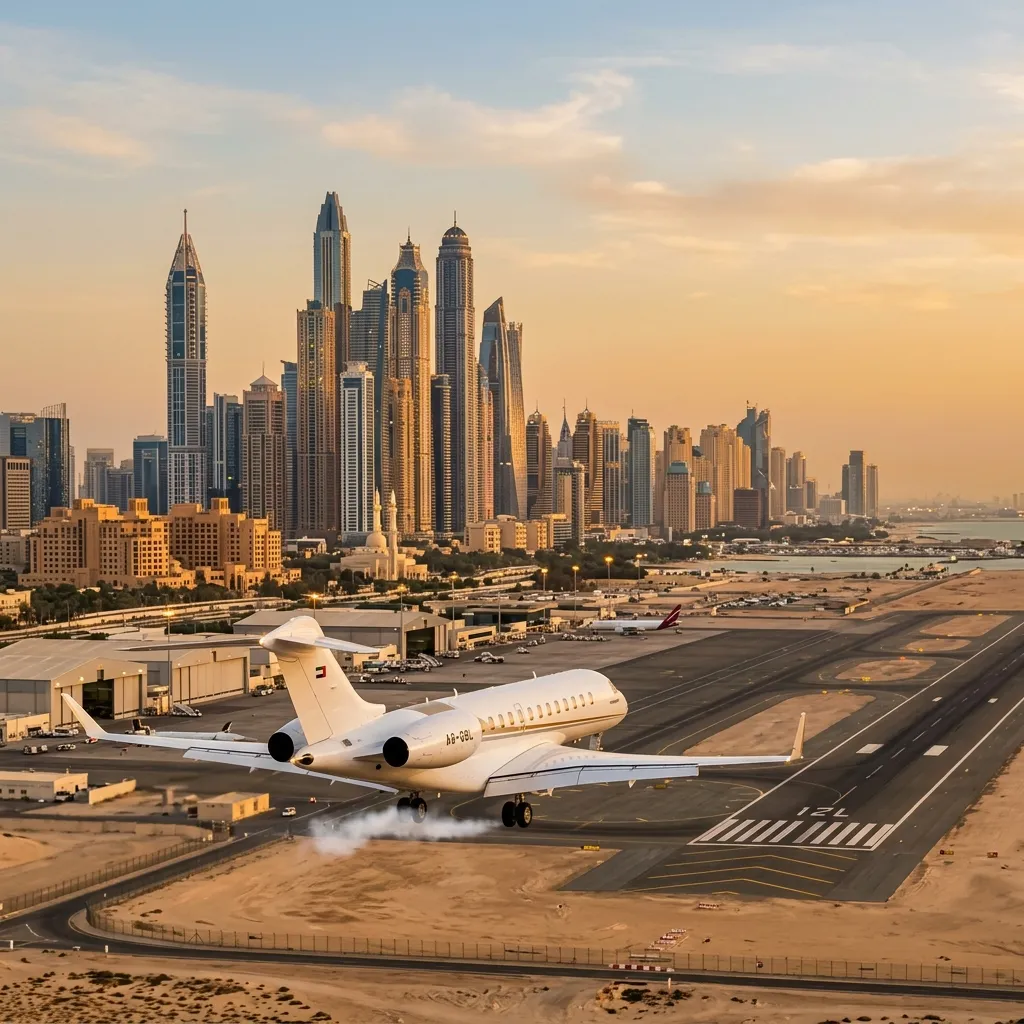
Modern Middle Eastern city skyline with a private jet on approach to land

Business Aviation in the Middle East: Dubai, Riyadh, and the Growth Trajectory

The Middle East business aviation fleet grew 18 percent since 2022. Saudi Arabia is building 14 new airports under Vision 2030. Dubai handles 5,600 business jet movements annually. The region's combination of sovereign wealth, infrastructure investment, and geographic positioning is creating the fastest-growing business aviation market outside the United States.

In This Article

Market Overview: Size, Growth, and Fleet Composition Saudi Arabia: Vision 2030 and Aviation Infrastructure UAE: Dubai and Abu Dhabi's Mature Market Qatar, Kuwait, and Emerging Markets Challenges: Regulatory Complexity and Summer Heat Frequently Asked Questions

Market Overview: Size, Growth, and Fleet Composition

The Middle East business aviation fleet comprises approximately 650 to 700 registered business jets across the Gulf Cooperation Council (GCC) states: UAE, Saudi Arabia, Qatar, Kuwait, Bahrain, and Oman. The fleet grew 18 percent between 2022 and 2025, driven by Saudi Arabia's economic diversification, Dubai's post-pandemic recovery, and increased intra-regional travel as Gulf economies reduce their oil dependence. By comparison, the U.S. fleet grew 4 percent and Europe grew 6 percent over the same period.

The fleet skews heavily toward large-cabin and ultra-long-range aircraft. Gulfstream G650ER, Global 7500, and Falcon 7X/8X models constitute approximately 45 percent of the registered fleet. The preference for heavy jets reflects the region's operating profile: distances between Gulf cities are short (Dubai to Riyadh: 525 NM), but the primary use case involves transcontinental travel to London (2,990 NM), New York (6,850 NM), and Asian capitals. Owners want aircraft that handle both the 1-hour regional hop and the 14-hour intercontinental mission.

Saudi Arabia: Vision 2030 and Aviation Infrastructure

Saudi Arabia is the fastest-growing business aviation market in the Middle East. The Kingdom's Vision 2030 economic plan includes $28 billion in aviation infrastructure investment, including 14 new airports and significant expansion of existing facilities. The General Authority of Civil Aviation (GACA) has liberalized private aviation regulations, reducing permit processing times from 72 hours to 24 hours for registered operators and allowing foreign-registered aircraft easier access to Saudi airspace.

Key Saudi Airports for Business Aviation

  • Riyadh King Khalid International (RUH): The primary business aviation hub with a dedicated general aviation terminal. SAR Aviation (formerly Saudia Private Aviation) operates the primary FBO. New FBO facilities under construction with completion targeted for 2027.
  • Jeddah King Abdulaziz International (JED): Gateway for Hajj and Umrah pilgrimages. Business aviation traffic is seasonal, peaking during Ramadan and Hajj. NasJet operates FBO services.
  • NEOM Bay Airport (NUM): New airport serving the $500 billion NEOM megaproject on the Red Sea coast. Runway operational since 2023 for construction-related flights. Commercial and private aviation operations expanding as NEOM development progresses.
  • The Red Sea International Airport (RSI): Serving the luxury Red Sea tourism development. Designed for 1 million passengers annually at full buildout. Private jet facilities integrated from initial design.

Saudi Arabia's Public Investment Fund (PIF) has acquired significant stakes in Gulfstream parent company General Dynamics and has placed orders for 25+ large-cabin jets through various government entities. The Kingdom's approach is systematic: build the infrastructure, liberalize the regulations, acquire the fleet, and create the demand through economic diversification that requires executives to travel between Riyadh, Jeddah, NEOM, and international capitals.

UAE: Dubai and Abu Dhabi's Mature Market

The UAE operates the most mature business aviation market in the region. Dubai World Central (DWC) handles 5,600 annual business jet movements with a dedicated VIP Terminal and four competing FBO operators (DC Aviation Al-Futtaim, Jetex, ExecuJet, Falcon Aviation). Abu Dhabi's Al Bateen Executive Airport (AZI) is the first purpose-built business aviation airport in the Middle East, handling 3,200 annual movements with a dedicated terminal and Jetex/ExecuJet FBO services.

The UAE's business aviation traffic patterns are event-driven. Five peak demand periods generate 60 percent of annual movements: Dubai Airshow (November, biennial), Abu Dhabi Grand Prix (November), Art Dubai (March), Dubai World Cup horse racing (March), and the holiday season (December 20 to January 5). During these events, FBO ramp space at DWC and AZI reaches capacity, fuel prices increase 10 to 15 percent, and hangar availability drops to zero for transient aircraft.

Need a Charter Quote?

Contact our team for a personalized quote.

Get a Quote

Qatar, Kuwait, and Emerging Markets

Qatar's business aviation market is concentrated at Doha Hamad International (DOH), where Qatar Executive (a subsidiary of Qatar Airways) operates a large-cabin managed fleet and FBO. Qatar Executive manages a fleet of 18 aircraft including G650ERs and Global 5000s, positioning the operation as both an operator and a handler. The Qatar Investment Authority's sovereign wealth ($475 billion) generates significant private aviation demand for government officials and fund managers traveling to investment destinations worldwide.

Kuwait's business aviation market centers on Kuwait International (KWI) where an estimated 150 business jets are registered, many owned by members of the ruling Al Sabah family and merchant families. The market is relatively mature but growing slowly compared to Saudi Arabia and the UAE. Bahrain's Al Muharraq airport handles approximately 800 business jet movements annually, serving as an overflow destination during peak UAE events due to its proximity to the Emirates (45-minute flight from DWC).

The Middle East business aviation market is bifurcated: the UAE and Qatar operate mature, well-serviced markets with established FBO infrastructure. Saudi Arabia is in build mode, constructing the airports, liberalizing the regulations, and acquiring the fleet simultaneously. The Kingdom's trajectory will determine whether the Middle East challenges Europe for the world's second-largest business aviation market by 2030.

Challenges: Regulatory Complexity and Summer Heat

Operating business jets in the Middle East presents specific challenges that do not exist in North American or European markets:

  • Landing permits: Every Gulf state requires advance landing permits for private flights. Processing times range from 24 hours (UAE, Saudi Arabia for registered operators) to 72 hours (standard). Each country has its own application process, fees, and documentation requirements. Multi-country trips (Dubai-Riyadh-Doha) require separate permits for each country plus overflight permits for transit airspace.
  • Summer operations: Ground temperatures exceed 50°C (122°F) in July and August across the Gulf. Aircraft engines lose thrust in extreme heat, requiring longer runways for takeoff. Cabin cooling systems run continuously, consuming fuel and increasing maintenance cycles. Many operators avoid Gulf summer operations for aircraft with older APUs that struggle to maintain cabin temperature on the ground.
  • Airspace complexity: The Gulf's small, densely packed countries create complex airspace coordination requirements. Iranian airspace restrictions affect routing for flights between the Gulf and Europe/Central Asia. Iraqi airspace overflight has normalized but still carries higher insurance surcharges.
  • Alcohol and cultural regulations: Crew rest regulations interact with local alcohol laws. Catering requirements differ by country (halal requirements). Passenger behavior standards that are routine in Western FBOs may conflict with local cultural expectations.
  • Sanctions compliance: U.S.-registered aircraft must comply with OFAC sanctions regarding Iranian, Syrian, and certain other restricted destinations. European operators face similar EU sanctions constraints. Sanctions compliance screening adds administrative overhead to every flight plan.
Brian Galvan

Written By

Brian Galvan

Founder, The Jet Finder · Private Aviation Operations & Technology

Former Director of Technology at FlyUSA (Inc. 5000 fastest-growing private jet company). Decade of hands-on experience across Part 135 operations, charter sales, fleet management, and aviation data systems.

LinkedInRead Full Profile →
Common Questions

Frequently Asked Questions


7 questions about Middle East business aviation market

The Middle East GCC states (UAE, Saudi Arabia, Qatar, Kuwait, Bahrain, Oman) collectively register approximately 650 to 700 business jets. Large-cabin and ultra-long-range aircraft (G650ER, Global 7500, Falcon 7X/8X) constitute approximately 45 percent of the fleet, reflecting the region's need for aircraft that handle both 1-hour regional hops and 14-hour intercontinental missions. The fleet grew 18 percent between 2022 and 2025, making it the fastest-growing business aviation market outside the United States.

Saudi Arabia's Vision 2030 plan includes $28 billion in aviation infrastructure investment covering 14 new airports and major expansions of existing facilities. Key projects include NEOM Bay Airport (serving the $500 billion NEOM megaproject), The Red Sea International Airport (luxury tourism), and expanded FBO facilities at Riyadh King Khalid International. The General Authority of Civil Aviation (GACA) has also liberalized permit processing from 72 hours to 24 hours for registered operators.

Yes. Al Bateen Executive Airport (AZI) in Abu Dhabi was designed and built specifically for business aviation operations. It handles approximately 3,200 annual movements with a dedicated executive terminal and FBO services from Jetex and ExecuJet. The airport accommodates aircraft up to Global 7500 size. Its location within Abu Dhabi city limits provides 10-minute ground transfer to the downtown business district, making it the most convenient executive airport in the Gulf region.

Five events generate approximately 60 percent of annual business jet movements in the UAE: Dubai Airshow (November, biennial), Abu Dhabi Grand Prix (November), Art Dubai (March), Dubai World Cup horse racing (March), and the holiday season (December 20 to January 5). During these periods, FBO ramp space at DWC and AZI reaches capacity, fuel prices increase 10 to 15 percent above standard rates, and hangar availability drops to zero for transient aircraft. Booking FBO services 2-4 weeks in advance is essential.

Qatar Executive is a subsidiary of Qatar Airways operating from Doha Hamad International (DOH). The division manages a fleet of 18 aircraft including Gulfstream G650ERs and Bombardier Global 5000s. Qatar Executive functions as both a charter operator and FBO handler, offering managed fleet services, ad-hoc charter, and ground handling. The operation is supported by Qatar Airways' maintenance infrastructure and the Qatar Investment Authority's $475 billion sovereign wealth fund, which generates significant travel demand.

Ground temperatures exceeding 50°C (122°F) in July and August affect Gulf operations in several ways: jet engines lose thrust in thin, hot air, requiring longer runways for takeoff; cabin cooling systems run continuously on the ground, consuming fuel and accelerating APU wear; flight crews face duty time limitations from heat exposure during pre-flight; and certain runway surfaces soften, requiring weight restrictions. Many operators schedule Gulf departures for early morning or late evening during summer to mitigate heat effects.

A multi-stop Gulf trip requires separate landing permits for each country plus overflight permits for transit airspace. A Dubai-Riyadh-Doha routing requires: UAE departure clearance, Saudi Arabia landing permit (24-72 hours advance filing through the ground handler), Saudi Arabia departure clearance, Qatar landing permit (filed through Qatar Executive or Jetex Doha), plus overflight permits for Omani or Bahraini airspace depending on routing. Each country charges separate permit fees ($200-$500 per country). Handlers coordinate the permits but the administrative overhead is significant.

Continue Reading

Related Articles


Your Next Mission

Ready to Fly?


Whether you need a charter quote or want to explore aircraft options, our team is here.

Contact Us