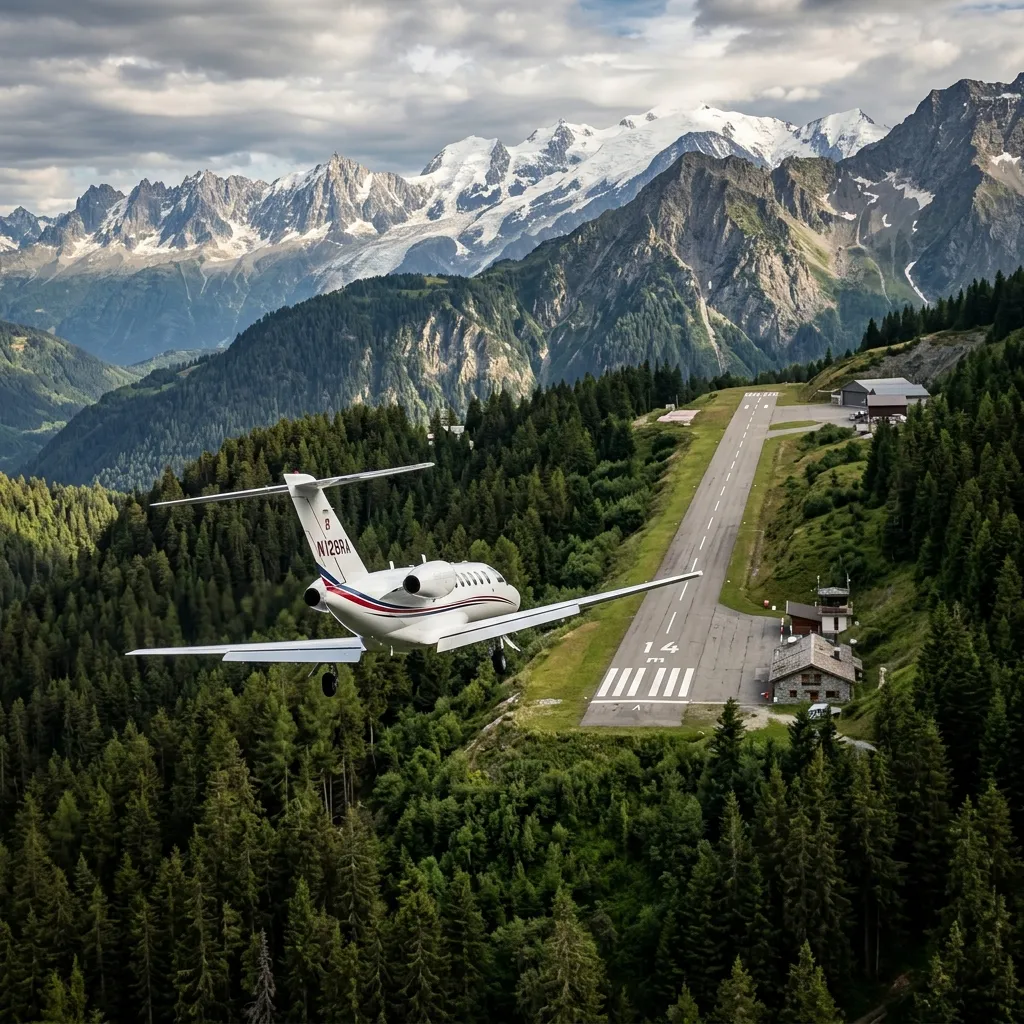
The Published Number Is Not Your Number
Every business jet manufacturer publishes a takeoff distance. That number is measured at sea level, ISA (International Standard Atmosphere) conditions, maximum takeoff weight, dry runway, and zero wind. It tells you what the aircraft can do in a test environment. It does not tell you what it can do at Aspen (7,820 ft elevation) in July (90°F) with four passengers and full fuel.
Density altitude is the variable that separates published performance from operational reality. At sea level on a standard day, a Pilatus PC-24 takes off in 2,930 feet. At Eagle County, Colorado (6,535 ft elevation) on a warm summer day, that distance stretches to approximately 5,500 feet. The aircraft did not change. The air did. Thinner air at altitude means less engine thrust and less wing lift.
Every jet on this list is evaluated at both its published sea-level distance and its practical operating capability. The question is not which jet has the shortest published number. It is which jets consistently operate from runways under 4,000 feet in real-world conditions at low-to-moderate elevation airports.
The Short-Field Leaders
The PC-12 NGX and TBM 960 are turboprops, not jets. They appear on this list because they are the aircraft most frequently chartered for short-runway destinations. A passenger chartering to Nantucket (6,303 ft, not an issue) or Block Island (2,502 ft, very much an issue) will encounter these turboprops as the only option for the shortest fields.
The Pilatus PC-24: Built for This
The PC-24 is the only business jet specifically designed for unpaved runway operations. Pilatus markets it as the Super Versatile Jet, and the certification backs the claim: the PC-24 is approved for operations from grass, gravel, and dirt strips. No other business jet in production carries this approval.
The PC-24's 2,930-foot takeoff distance at sea level is competitive with the lightest VLJs, but it delivers midsize-level cabin space. The cargo door on the left side of the fuselage opens to a flat-floor cabin that accommodates medical stretchers, oversized luggage, and equipment that would not fit through a standard jet cabin door. For remote mining operations, wilderness lodges, and bush-accessible destinations, the PC-24 occupies a category of one.
Charter rates for the PC-24 run $3,200 to $4,500 per flight hour, positioning it between light jets and midsize jets. The premium over a Phenom 300 ($2,800 to $3,400/hr) reflects the runway access capability and the cargo flexibility.
Airports Where Short-Field Capability Matters
In the continental United States, short-field capability matters at roughly 150 airports that receive regular business jet traffic. These include Block Island (BID, 2,502 ft), Shelter Island (not served), Fishers Island (0B8, 2,334 ft), and numerous mountain and island destinations.
Nantucket (ACK, 6,303 ft) and Martha's Vineyard (MVY, 5,504 ft) are often cited as short-field destinations, but their runways are long enough for any midsize jet. The real short-field challenge in the Northeast is the sub-3,500-foot strips: Stowe-Morrisville (MVL, 3,700 ft) in Vermont, Katama Airpark (1B2, 2,300 ft) on Martha's Vineyard, and the numerous New England grass strips that only turboprops can reach.
In the West, the challenge is elevation compounding short runways. Telluride (TEX, 7,111 ft at 9,070 ft elevation) is technically a long runway, but the elevation reduces effective performance so dramatically that only light jets and turboprops operate there safely with passengers. Mammoth Yosemite (MMH, 7,000 ft at 7,128 ft elevation) presents similar constraints.
The Midsize Barrier
Midsize and super-midsize jets generally require 4,500 to 6,000 feet for takeoff at sea level. At elevation, that extends to 6,500 to 8,000+ feet. This effectively excludes the Citation XLS, Hawker 800XP, Challenger 350, and Gulfstream G280 from true short-field operations.
The Cessna Citation Latitude, at 3,580 feet takeoff distance at sea level, is the midsize jet that gets closest to short-field territory. But at elevation, it needs significantly more runway. The Latitude works at Centennial Airport (APA, 10,001 ft at 5,885 ft elevation) but not at Aspen (ASE, 8,006 ft at 7,820 ft elevation) under all conditions.
If your destination has a runway under 4,000 feet at sea level, you are flying a light jet, a VLJ, or a turboprop. There are no exceptions in this physics equation.
Choosing the Right Aircraft for Your Short Runway
Start with the destination, not the aircraft. Determine the runway length, elevation, and typical temperature range. Your charter operator's dispatch team runs the performance calculations for the specific conditions on the day of your flight. A runway that works in January may not work in July due to temperature-driven density altitude increases.
For runways 3,500 to 4,000 feet at low elevation, any light jet on this list works. For runways 2,500 to 3,500 feet, narrow the field to the PC-24, Phenom 100, HondaJet, or turboprops. Below 2,500 feet, only turboprops and the Eclipse 550 are candidates, and pilot experience with the specific strip becomes the deciding factor.
The charter cost differential between a turboprop and a light jet is approximately $1,000 to $1,500 per flight hour. If your destination requires a turboprop, the savings over a jet that cannot get in are not savings. They are the cost of access.