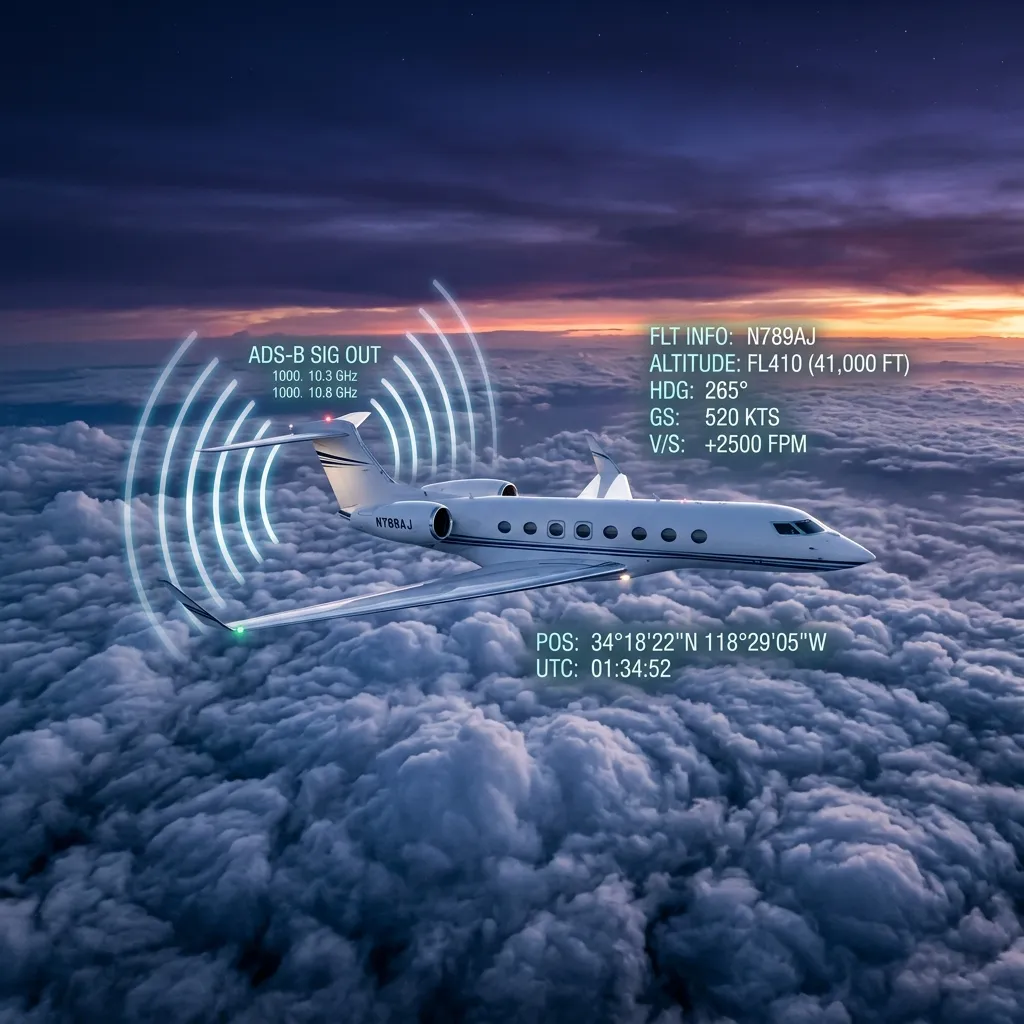
What ADS-B Changed and Why It Cannot Be Undone
On January 1, 2020, the FAA's ADS-B Out mandate went into effect, requiring every aircraft operating in most controlled airspace to broadcast its position, altitude, and identity on 1090 MHz. Before that date, a business jet could cross the country without generating a single publicly visible data point. Radar coverage had gaps: between stations, over rural areas, over oceans, and below certain altitudes, an aircraft was invisible to anyone outside the ATC system. ADS-B eliminated those gaps permanently.
ADS-B Out, mandatory since January 1, 2020 for aircraft operating in most controlled airspace, changed the equation permanently. The aircraft itself broadcasts its ICAO 24-bit address, GPS position, altitude, velocity, and call sign on 1090 MHz Extended Squitter. Anyone with a $20 USB receiver and a Raspberry Pi can receive those broadcasts within approximately 250 miles. Thousands of hobbyists, flight tracking companies, and data aggregators do exactly that.
FlightAware, Flightradar24, ADS-B Exchange, and JetSpy aggregate this data from 35,000+ ground receivers worldwide into real-time tracking platforms accessible to anyone with an internet connection. The result: every business jet movement is logged, timestamped, and archived. Where the jet went, when it departed, when it arrived, how long it stayed, and which airports it visited. The data is permanent.
LADD: The FAA's Privacy Shield and Its Limits
The FAA's Limiting Aircraft Data Displayed (LADD) program allows aircraft owners to request that their tail number be blocked from the FAA's ADS-B data feed to third-party tracking services. As of 2024, approximately 387 aircraft were enrolled in LADD, up from fewer than 100 before 2020.
LADD blocks data at the FAA distribution level. FlightAware, Flightradar24, and other services that receive data through FAA SWIM (System Wide Information Management) will not display LADD-enrolled aircraft. The tail number disappears from their platforms.
The problem: LADD only blocks FAA-distributed data. It does not block the raw ADS-B radio signal. Anyone operating a ground receiver within range of the aircraft can still capture the broadcast, decode the ICAO address, and correlate it to the aircraft's registration. ADS-B Exchange, which operates independently of FAA data feeds and sources data directly from community receivers, does not honor LADD blocks. If you are on LADD, FlightAware will not show your flight. ADS-B Exchange will.
This created a two-tier tracking landscape. Casual observers using FlightAware or Flightradar24 cannot find LADD aircraft. Motivated observers using ADS-B Exchange or their own receivers can. The distinction between "I cannot be tracked" and "most people cannot easily track me" is significant for high-profile aircraft owners.
PIA: Changing Your Aircraft's Digital Fingerprint
The Privacy ICAO Address (PIA) program, launched by the FAA in 2020, assigns aircraft a temporary ICAO 24-bit address that is not linked to the tail number in public databases. The FAA rotates the PIA code periodically and maintains the real registration internally for ATC purposes. To a tracking receiver, a PIA-equipped aircraft appears with a random ICAO code that does not resolve to any known tail number.
The FAA has issued over 2,800 PIA codes as of early 2026. Demand surged after a series of high-profile tracking incidents involving billionaire-owned aircraft, political figures, and celebrity jets. PIA is more effective than LADD alone because it attacks the problem at the broadcast level: the aircraft transmits a code that cannot be easily tied to the owner.
Weaknesses of PIA
- Pattern analysis: A jet that always departs from the same private hangar at TEB and always parks at the same FBO at VNY is identifiable by behavior even with a randomized ICAO code.
- ATC voice comms: If the pilot uses the actual tail number on air traffic control radio frequencies, anyone monitoring ATC audio (available through LiveATC.net) can correlate the PIA code to the real registration.
- FBO logs: Ground handling, fuel records, and flight plans contain the actual registration. Data breaches or public records requests can expose movements.
- Photo correlation: Plane spotters at airports photograph aircraft and post images with visible tail numbers. A PIA code is irrelevant if the tail number is painted on the fuselage.